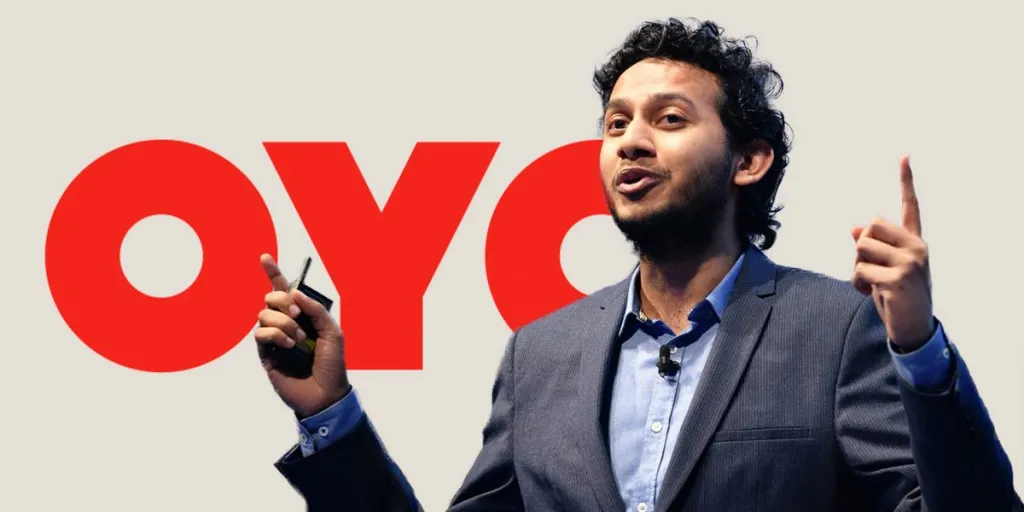
When the COVID-19 pandemic brought global travel to a standstill, hospitality startups were among the worst hit. For OYO, once celebrated as India’s fastest-growing hospitality unicorn, the crisis became an existential test. Revenues collapsed, properties shut down, layoffs followed, and questions around sustainability grew louder.
Yet, by FY23–FY24, OYO returned to profitability, surprising critics and resetting its growth narrative. At the center of this turnaround stood Ritesh Agarwal, whose decisive post-COVID pivots transformed OYO from a growth-at-all-costs startup into a disciplined, profitability-focused hospitality platform.
This is the story of how OYO reinvented itself after COVID and what Indian founders can learn from it.
The Pre-COVID OYO Model: Growth Over Governance
Before the pandemic, OYO’s strategy was built on aggressive global expansion, rapid hotel onboarding, heavy discounting, and prioritising market share over margins. While this helped OYO scale to more than 80 countries and thousands of properties, it also created deep structural issues. Customer acquisition costs were high, quality varied widely, franchisee dissatisfaction grew, and operational losses kept mounting.
COVID exposed these weaknesses with brutal clarity.
COVID Became a Strategic Reset for OYO
Instead of treating COVID as a temporary disruption, Ritesh Agarwal used it as a reset button. Travel demand collapsed, but so did unnecessary costs. OYO’s leadership recognised that survival would depend not on scale, but on sustainability. This insight triggered a multi-year transformation across markets, operations, and culture.
Exiting Unprofitable Markets and Cutting Costs
One of the boldest post-COVID decisions was OYO’s exit from unviable international markets. The company shut operations in several non-core geographies, reduced workforce size to align with leaner operations, and consolidated teams and technology functions.
Rather than chasing global vanity metrics, OYO doubled down on India and a few high-margin regions in Europe and Southeast Asia. The focus shifted firmly to unit economics and cash flow discipline.
From Asset-Light Chaos to an Asset-Right Strategy
Before COVID, OYO’s asset-light approach meant onboarding almost any hotel willing to partner. Post-pandemic, the company pivoted to an “asset-right” model. OYO began working with fewer but higher-quality hotels, prioritising longer-term contracts and stronger owner alignment.
This shift improved guest experience, increased repeat bookings, and restored trust among hotel partners. Quality replaced quantity as the growth mantra.
Profitability Replaced GMV as the Core Metric
Pre-COVID, Gross Merchandise Value was a key success metric for OYO. After the pandemic, profitability became the north star. The company reduced aggressive discounting, focused on positive contribution margins per booking, and introduced stricter performance benchmarks for properties.
This cultural shift from storytelling around scale to focus on business fundamentals played a crucial role in rebuilding investor confidence.
Technology-Led Efficiency Over Manpower Expansion
OYO leaned heavily into automation and technology to improve efficiency. The company deployed AI-driven pricing systems, automated demand forecasting, fraud detection tools, and centralised customer support platforms. Inventory and yield management systems were strengthened to improve margins.
These changes allowed OYO to handle higher booking volumes with fewer resources, directly boosting operational efficiency.
Rebuilding Franchisee Trust and Economics
One of the strongest criticisms against OYO before COVID was its strained relationship with hotel partners. Post-COVID, the company reworked its franchise model to ensure transparent revenue sharing, predictable payouts, and healthier partner economics.
As trust improved, property performance followed, creating a more stable and collaborative ecosystem.
India Emerged as OYO’s Profit Engine
India became OYO’s strongest profitability driver in the post-pandemic period. Domestic travel recovered quickly, budget hotel demand surged, and OYO benefited from strong brand recall among Indian travellers.
By prioritising its home market, OYO built a stable cash-generating base instead of chasing uncertain global expansion.
The Outcome: A Profitable OYO
By FY23–FY24, OYO reported consistent quarterly profitability, improved cash flows, reduced debt pressure, and tighter operational discipline. While IPO plans remain cautious, OYO’s turnaround is now seen as one of India’s most notable post-COVID startup pivots.
Key Lessons for Startup Founders
OYO’s transformation offers clear lessons for Indian founders. Growth without margins is fragile. Crises can serve as strategic reset points. Founder conviction matters most during downturns. Strong unit economics outperform vanity metrics. Profitability is the most credible growth story in uncertain markets.
Conclusion
Ritesh Agarwal didn’t just help OYO survive the pandemic. He redefined what success looked like for the company. By prioritising profitability, operational discipline, and long-term value creation, OYO evolved from a loss-making hyper-growth startup into a more mature hospitality business.
In India’s startup ecosystem, OYO’s journey stands as proof that enduring companies are built not just by scaling fast, but by knowing when to slow down, fix fundamentals, and rebuild stronger.