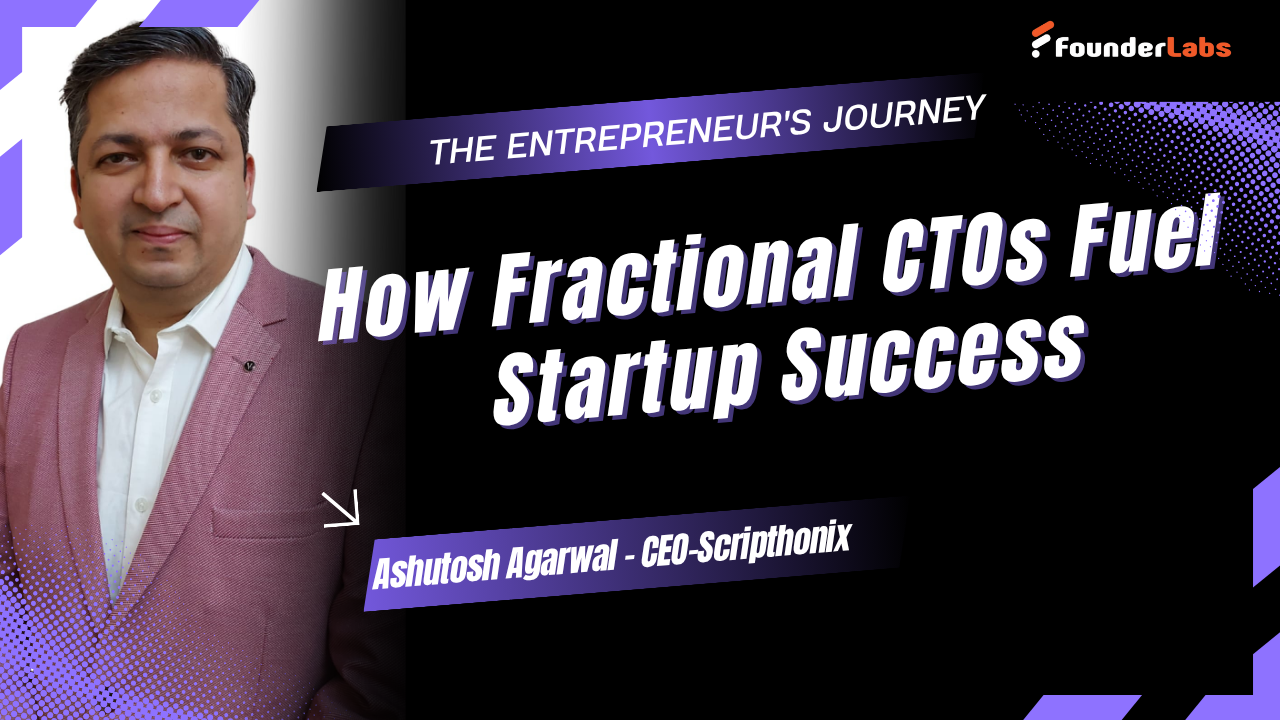
The Founder’s Journey: Strategic Pivots That Shape Startup Strategy
Every founder eventually faces a moment when the original idea stops matching market reality. The evolution of Scripthonix Solutions—led by Ashutosh Agarwal, Chief AI Officer—illustrates exactly why pivots are not failures but strategic recalibrations.
Scriptonics began in EdTech, building self-paced learning programs for children. However, despite a compelling product, the high cost of customer acquisition and low parent engagement made the model unsustainable. Instead of pushing forward blindly, the team made a deliberate pivot rooted in Ashutosh’s 25+ years of global experience.
The company restructured its offering into three high-value verticals:
- Fractional CTO support for early-stage companies needing senior technical leadership without full-time costs
- AI workshops for non-technical founders seeking clarity
- Data and tech audits for institutions like schools
This shift instantly aligned the business with market demand. For young startups—especially those with non-technical founders—the Fractional CTO model acts as a safety net, ensuring smart MVP decisions, correct build-vs-buy choices, and efficient use of limited capital.
AI-Led Innovation: Building a Competitive Edge With Data & Smart Execution
In today’s landscape, no company can build enduring value without a thoughtful AI and data strategy. Yet many early-stage founders either overspend or under-plan.
Ashutosh highlights a simple but powerful principle:
Use off-the-shelf AI tools for 80–90% of your needs in the early stages.
This prevents unnecessary burn and accelerates execution.
However, as a company grows—especially approaching Series A—it must create its own defensible edge. This requires:
- A dedicated AI champion to steer the roadmap
- Investment in data engineering to build reliable pipelines
- Designing proprietary AI applications that become a long-term moat
- Implementing guardrails, including RAG (Retrieval-Augmented Generation), with carefully curated data
Many startups underestimate how quickly AI API calls can inflate burn rates. Clear boundaries, domain-specific data, and internal expertise prevent costly mistakes and keep teams focused on value creation—not just experimentation.
India vs. Silicon Valley: Funding Culture, DeepTech Ambition & the Rise of Indicorns
Ashutosh’s experience across global ecosystems reveals sharp contrasts in how entrepreneurship unfolds in India versus Silicon Valley. While global markets enjoy patient capital and mature customer bases willing to pay premium prices, India offers something equally powerful: a deep reservoir of talent.
Yet, cultural gaps still exist. Productivity norms, time discipline, and comfort with taking risks remain areas of improvement for the Indian ecosystem.
The recent announcement of the ₹1-lakh-crore RDI Fund is a breakthrough. For the first time, Indian founders working on DeepTech, AI, and research-heavy products will gain access to long-term capital—crucial for building intellectual property rather than chasing fast revenue.
Ashutosh also champions the rise of Indicorns—profitable, capital-efficient startups generating ₹20–40 crore in revenue. Instead of chasing unicorn valuations, this model promotes sustainable scaling. Empowering 75,000 such companies, he argues, could generate 25–50 lakh jobs within six years. This shift would fundamentally transform India’s entrepreneurial landscape.
Creativity & Clarity: Strengthening the Founder Mindset for Sustainable Scaling
Entrepreneurship is not just strategy—it’s emotional endurance. Founders constantly make decisions with incomplete information, requiring intuition and creativity. To stay sharp, leaders must cultivate habits that restore energy and clarity.
Ashutosh recommends books that sharpen practical thinking:
- The Goal for understanding bottlenecks and risk
- Atomic Habits for building consistent execution
- Neuromarketing for understanding customer psychology
Yet, the most overlooked aspect of founder wellbeing is unwinding. Whether it’s spending time with family, engaging in hobbies like singing, or creatively expressing oneself—these moments recharge the mind and prevent burnout.
His final message is both encouraging and grounding:
This is one of the most exciting times to be an entrepreneur in India. But success depends on having the right co-founder, a supportive environment, and a mindset that balances ambition with clarity.