WHAT THIS ARTICLE IS — India’s government has committed more capital to startups than at any point in the country’s history. Most founders never claim a rupee of it. This guide maps every scheme available in 2026 — from the free DPIIT registration that unlocks tax exemptions, to the ₹1 lakh crore RDI Fund for deep-tech founders, to the credit guarantee that lets you borrow without collateral — so you spend less time searching and more time building.
India’s government has, over the past two years, committed more capital to startup funding than at any previous point in the country’s history. The problem is not the money. It is that most founders never claim it. As of December 2025, India has officially recognised over 2,07,135 startups, which have collectively created more than 21.9 lakh direct jobs. The policy infrastructure supporting them spans seed grants, venture funds, long-term innovation loans, credit guarantees, and sector-specific programmes — each with its own portal, its own eligibility rules, and its own calendar. This article maps the landscape so founders spend less time searching and more time building.
DPIIT recognition is free, takes a fortnight, and unlocks every scheme in this guide.
The entry point for almost every central government scheme is DPIIT recognition under the Startup India programme. It is free, processed entirely online through the National Single Window System, and takes seven to fifteen days. The eligibility conditions are not onerous: register as a Private Limited Company, LLP, or Partnership; be less than ten years old; keep annual turnover below ₹100 crore; and demonstrate work on innovation or improvement of products or services. What recognition unlocks, however, is substantial. Section 80-IAC of the Income Tax Act provides a 100% profit exemption for any three consecutive financial years out of the first ten — a tax saving that can run to ₹20–50 lakh for a profitable early-stage company. The angel tax, which previously applied to investments received above fair market value, was abolished effective FY 2025-26, removing a meaningful friction point for founders raising from friends, family, and angel networks. Self-certification under six labour laws and three environmental laws cuts compliance overhead at the stage when every working hour matters most.
Seed stage: Startup India Seed Fund Scheme (SISFS)
For founders at the earliest stages — before there is a product, before there is revenue, and long before there is a term sheet — the Startup India Seed Fund Scheme (SISFS) is the most directly relevant instrument. With a total corpus of ₹945 crore, the scheme disburses capital through DPIIT-recognised incubators rather than directly to startups. A founder applies through the Startup India portal to up to three incubators simultaneously, is evaluated by an Incubator Seed Management Committee, and if selected, receives up to ₹20 lakh as a non-repayable grant for proof-of-concept, prototype development, or product trials — disbursed against milestones. A further ₹50 lakh is available as debt or convertible debentures for market entry and commercialisation. The scheme is sector-agnostic and does not require physical presence at the incubator. It is designed precisely for the stage where banks demand collateral that does not yet exist and angel investors want traction that has not yet been built.
Growth stage: Fund of Funds for Startups
Beyond the seed stage, the primary vehicle for government-catalysed equity is the Fund of Funds for Startups. The original programme committed its full ₹10,000 crore corpus to 145 SEBI-registered Alternative Investment Funds, which in turn deployed more than ₹25,500 crore into over 1,370 startups spanning artificial intelligence, clean tech, healthcare, fintech, manufacturing, and space — a 2x private capital multiplier built into the scheme’s structure, since every rupee committed by the government required at least two rupees invested in startups by the fund. The Union Cabinet approved Fund of Funds 2.0 on February 14, 2026, with a fresh ₹10,000 crore corpus and an enhanced focus on deep tech, AI, clean energy, and manufacturing. Founders cannot apply to the fund directly. The route is to identify SEBI-registered AIFs empanelled under the scheme and approach them through standard fundraising channels.
Deep tech: Research, Development and Innovation (RDI) Fund
The most significant new instrument for deep-tech founders is the Research, Development and Innovation Fund — a ₹1 lakh crore, six-year programme approved by the Union Cabinet on July 1, 2025 and formally launched by Prime Minister Modi on November 3, 2025. The fund, housed under the Anusandhan National Research Foundation, targets private enterprises working in AI, quantum computing, clean energy, biotechnology, space, robotics, and semiconductors at Technology Readiness Levels 4 to 6. It operates not as a grant but as a revolving fund: capital is disbursed as long-term loans at 3% to 4% interest with tenures of 12 to 15 years, equity participation of up to 25%, or hybrid structures. The first call for proposals went live on February 1, 2026, managed by the Technology Development Board for all strategic sectors and BIRAC for biotechnology and allied domains — each seeded with ₹2,000 crore. By April 30, 2026, the system had received 124 proposals worth over ₹25,000 crore. The first cheques were issued in May 2026, including ₹50 crore to Bengaluru-based cell therapy startup IISTEM Research.
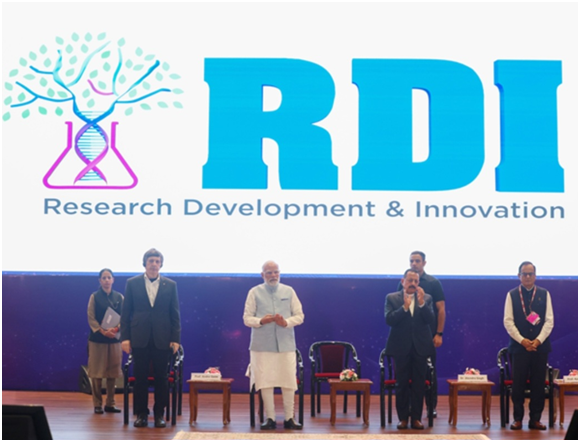
At ₹1 lakh crore over six years, the RDI Fund is the largest deep-tech capital commitment in India’s history.
Budget 2026-27, presented by Finance Minister Nirmala Sitharaman on February 1, 2026, added further layers to this architecture. A ₹10,000 crore SME Growth Fund was announced to provide equity and quasi-equity to MSMEs with export potential and technical capabilities. A separate ₹10,000 crore Biopharma SHAKTI programme, managed by the Department of Pharmaceuticals, targets startups and MSMEs building biologics, biosimilar drugs, and medical devices over the next five years. As of March 2026, detailed operational guidelines for SHAKTI were still being finalised — a common pattern with newly announced schemes, which typically release their full application framework three to six months after a budget announcement. For biotech founders who cannot wait, BIRAC’s Biotechnology Ignition Grant provides up to ₹50 lakh as a non-dilutive grant for proof-of-concept validation at an earlier stage, evaluated through the BIRAC portal by domain experts.
Debt without collateral: Credit Guarantee (CGTMSE)
For founders who want debt without collateral rather than equity or grants, the Credit Guarantee Fund Trust for Micro and Small Enterprises (CGTMSE) provides the key backstop. In 2025, the startup guarantee limit under the scheme was raised from ₹10 crore to ₹20 crore, a change projected to unlock an additional ₹1.5 lakh crore in MSME credit over five years. The guarantee covers up to 80% of the loan value, substantially reducing the risk a bank absorbs when lending to an early-stage company without hard assets. Access is through a standard bank loan application: the bank initiates the CGTMSE guarantee process. Udyam registration is required.
The honest summary of this landscape is that India’s government funding infrastructure is not under-resourced — it is under-navigated. The schemes above collectively represent capital commitments that dwarf anything available to Indian founders a decade ago. The practical challenge is that each instrument has a separate portal, a separate eligibility matrix, and a separate application window. SISFS accepts applications continuously; RDI Fund calls are time-bound; Biopharma SHAKTI guidelines are still being notified; state-level programmes in Karnataka, Maharashtra, and Telangana run on entirely independent cycles. The founders who access this capital most effectively are those who treat government schemes as a deliberate component of their funding strategy from day one — not a fallback when private capital runs out. DPIIT recognition costs nothing and takes a fortnight. The capital is available. The process of claiming it is slower, more bureaucratic, and almost always worth it.