Zepto’s Aadit Palicha is 24, valued at $7 billion, and deeply unimpressed with where India’s startup ecosystem thinks it stands.
WHAT THIS ARTICLE IS — Aadit Palicha is 24 years old, runs a $7 billion company, and believes Indian founders are fundamentally aiming too small. This profile, compiled from his public interviews and talks, is an unfiltered look at why the CEO of Zepto thinks the ecosystem is celebrating a race that has barely started — and what he is building to prove the ceiling was never the problem.
MUMBAI — By most measures, Aadit Palicha has arrived. The Stanford dropout co-founded Zepto with Kaivalya Vohra in 2021 during a pandemic lockdown — in a WhatsApp group — and has since built it into a ₹11,110 crore revenue business growing at 149 per cent year-on-year, valued at $7 billion, with an IPO on the horizon. He is 24 years old.
In a candid conversation with Y Combinator CEO Garry Tan on YC’s “How to build the Future” podcast, Palicha delivered a pointed critique of the Indian startup ecosystem.
“People are celebrating too early. There’s a mindset of ‘we’ve arrived’ when really, the journey’s just started,” Palicha told Tan. “I think there’s a deep under-estimation of what Indian founders can achieve.”
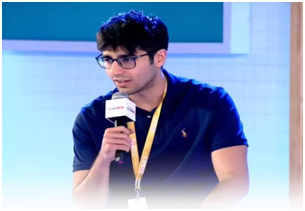
Aadit Palicha, 24, co-founder and CEO of Zepto — Stanford dropout, quick-commerce disruptor, and one of India’s most vocal critics of the ecosystem he’s helped build.
THE AMBITION PROBLEM
Palicha’s critique is not about work ethic — a distinction he has been careful to make, especially after a December 2024 post on work-life balance he later called a “stupid idea.” His concern runs deeper: a structural deficit of vision, not hours.
In conversations with investors and podcast hosts, he has drawn a pointed contrast with the US and China, where founders set out from day one to dominate entire industries. In India, he argues, the instinct often runs the other way. “In the US or China, founders start off wanting to dominate entire industries. In India, we often want to solve a neighbourhood problem and stop there.”
He reaches for the post-dotcom crash as analogy: a generation of founders retreated into caution and incremental thinking after 2001. India’s founders, he believes, are doing something similar — internalising the capital correction of 2022–23 as a permanent disposition rather than a temporary market condition.
THE TALENT PARADOX
What sharpens Palicha’s frustration is his conviction that India’s talent pool is genuinely world-class. Managing nearly 17,000 employees, he says the engineers he hired in India matched — and in many cases exceeded — the Americans he interviewed. “The guys that we have here are just as good.”
India has over 100 unicorns and the third-largest startup base in the world. Yet almost none are household names outside the subcontinent. The raw material — engineering depth, problem-solving ability, cost advantage — is present. What is missing, in Palicha’s reading, is the ambition layer that converts those inputs into globally scaled outputs.
WHAT ZEPTO IS TRYING TO PROVE
Zepto has long outgrown its original description as a 10-minute grocery app. Its catalogue now spans over 50,000 products — fresh produce to electronics. Advertising revenue grew 151 per cent year-on-year to ₹16.4 billion in FY26. Palicha describes the ambition as building “an internet supermarket chain”, not a logistics provider.
The mission, he says, is also a management tool. “If you don’t have something ambitious to work toward, why would anyone give their best?” When asked whether India’s startup ecosystem has definitively arrived as a global force, his answer was unambiguous: “No. Not even close to it. I think we’ve got a couple of decades before we can realistically say that we’ve won.”

Zepto’s dark store operations — a catalogue of 50,000+ products, advertising revenue up 151% YoY, and a mission Palicha calls building “an internet supermarket chain.”
THE HARDER QUESTION
Whether the problem is really mindset — or something more structural, like shallow exit markets, limited long-horizon capital, and incentive structures that rationally reward small wins — is a debate Palicha does not fully resolve. Founders who aim small may simply be reading the room correctly.
His counterargument is implicit in Zepto’s own story. The infrastructure was never the bottleneck, the company seems to suggest. The ceiling was. Whether the ecosystem is ready to hear that, Palicha does not appear to be slowing down long enough to find out.