


WHAT THIS ARTICLE IS — 488 million rural Indians are online, and they are buying beauty products, not just rations. Yet most Indian startups are still built for metro consumers who represent a fraction of the available market. This is a tactical field guide to distribution in Bharat — covering language, WhatsApp, UPI failure states, and community-first trust networks — for any founder serious about reaching the next hundred million users.
For years, Indian startups were built with one eye fixed on Bengaluru, Mumbai, and Delhi. The metro consumer was the template — English-speaking, credit-card-wielding, and familiar enough with apps that onboarding required little hand-holding. That era is ending. The numbers don’t just suggest a shift; they announce one.
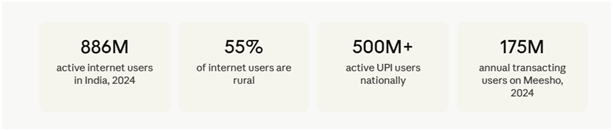
India’s active internet user base reached 886 million in 2024, with rural India accounting for 488 million users — 55% of the total internet population. These are not passive users. Rural India now leads in OTT streaming, social media use, and online communication. The next wave of growth isn’t coming from South Mumbai high-rises. It’s coming from Gorakhpur, Tiruppur, Siliguri, and thousands of towns in between.

India’s 488 million rural internet users are no longer passive — they lead in OTT streaming, social media use, and online communication. The next wave isn’t coming from metro high-rises.
The Myth of the ‘Affordable’ Play
The biggest mistake founders make when building for Bharat is conflating ‘Tier-2’ with ‘cheap.’ Price sensitivity exists, but it isn’t the whole story. Categories like beauty and personal care, and home and kitchen saw a cumulative 70% year-on-year growth in orders on Meesho in 2024 — these are aspiration-driven categories, not just utility purchases. States like Ladakh, Uttar Pradesh, and Bihar have emerged as frontrunners in e-commerce user growth, highlighting the vast untapped potential of tier-2+ markets.
The consumer here wants quality and value simultaneously. Building exclusively on price is a race to the bottom. Building on trust, relevance, and accessibility is a race to the top.
Language is the Product
Distribution in Bharat begins with language, not logos. Indic languages — including Tamil, Telugu, and Malayalam — are shaping internet consumption, with 98% of users accessing content in these languages. Critically, 57% of urban internet users also prefer regional language content, meaning vernacular isn’t a concession for rural audiences — it’s increasingly mainstream.
YouTube India reported in 2024 that over 60% of its watch time comes from regional language videos, led by creators producing content in Tamil, Telugu, and Bhojpuri. Brands that communicate only in English are essentially whispering to a crowd that speaks in a dozen other tongues. Founders need to treat regional-language content not as a translation exercise but as a primary product decision — interfaces, support, marketing, and storytelling should all be vernacular-first.
WhatsApp is Infrastructure
Metro startups rely on push notifications and email funnels. In Tier-2 India, WhatsApp is the internet. It is how communities organise, how trust is built, and how word spreads. Meesho understood this early — its original model relied entirely on social selling via WhatsApp and Facebook by micro-entrepreneurs, mostly women, who acted as hyper-local distribution nodes. Around 80% of Meesho’s resellers are women, most of whom had never worked outside their homes before.
The lesson for founders isn’t ‘put a WhatsApp button on your website.’ It’s deeper: build products that can travel through social networks organically. If your product requires a 12-step onboarding flow that only works on a stable 4G connection, it will not survive contact with Tier-2 India.
UPI changed the Game — But unevenly
Payment infrastructure has improved dramatically. According to an EY-CII report, UPI is the most preferred transaction mode for nearly 38% of users in rural and semi-urban India, and UPI now has over 500 million active users across the country. For founders, this means cash-on-delivery can no longer be the default assumption — digital payment adoption is real and growing fast.
However, friction still exists. An RBI 2024 survey found that 30% of rural users faced UPI failures — apps freezing, payments timing out, or biometric scans not working. Designing for low-connectivity environments, offering offline fallbacks, and keeping transaction flows minimal are non-negotiable for products targeting deeper geographies.
Trust is the distribution Moat
In metros, a brand wins by being convenient. In Bharat, a brand wins by being trusted. That trust is earned through familiarity — a local influencer who speaks the user’s dialect, a seller who offers returns without questions, an app that works on a 2GB RAM phone just as smoothly as on a flagship. Meesho reached approximately 175 million annual transacting users in 2024, with nearly 50% of its user base coming from Tier-4+ towns — places like Naidupeta in Andhra Pradesh and Sherghati in Bihar.

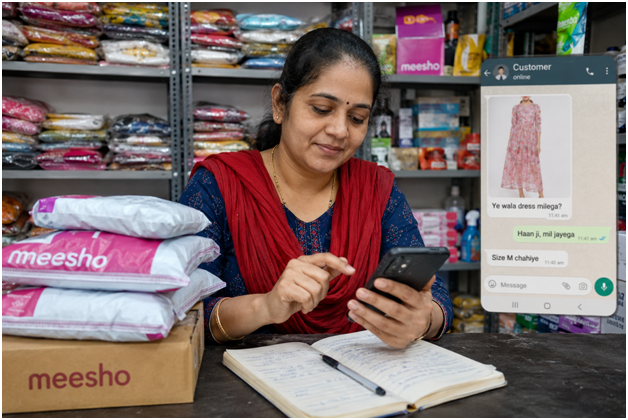
Meesho reached 175 million annual transacting users in 2024 — nearly 50% from Tier-4+ towns. The engine wasn’t performance marketing. It was trust, community, and 80% women resellers selling through WhatsApp.
The playbook here is community before conversion. Founders building for Bharat must invest in local trust networks — kirana partnerships, self-help groups, regional micro-influencers — before they invest in performance marketing. The funnel is inverted: community builds awareness, awareness drives trial, trial earns loyalty.
The Tactical Checklist
For any founder serious about Bharat distribution, the essentials are non-negotiable: build a vernacular-first interface and support system; design for sub-4G connectivity and low-end Android devices; distribute through WhatsApp and regional social networks, not just the app store; partner with local trust nodes — kiranas, SHGs, agents — rather than relying solely on digital acquisition; and price in EMI and UPI, but design for failure states.
Bharat is not a market to be cracked with a metro playbook run on a tighter budget. It is a fundamentally different context — one that rewards patience, localisation, and infrastructure-awareness. The founders who understand that will not just find users here. They will find the next hundred million.


